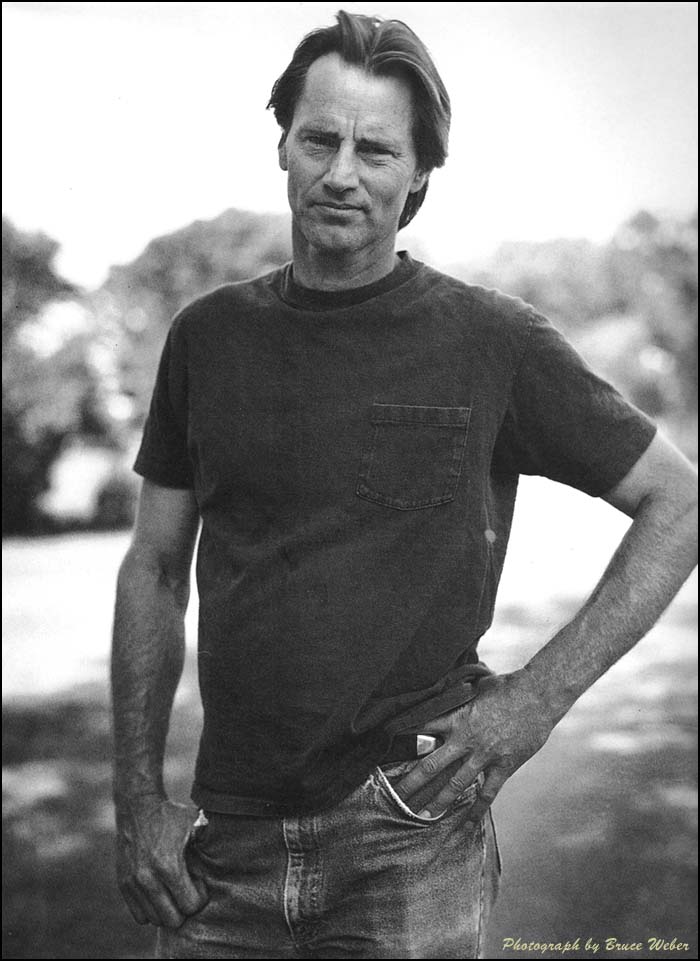
Sam Shepard ranks as one of
America's most celebrated dramatists. He has written
nearly 50 plays and has seen his work produced
across the nation, in venues ranging from Greenwich
Village coffee shops to regional professional and
community theatres, from college campuses to
commercial Broadway houses. His plays are regularly
anthologized, and theatre professors teach Sam
Shepard as a canonical American author. Outside of
his stage work, he has achieved fame as an actor,
writer, and director in the film industry. With a
career that now spans nearly 40 years, Sam Shepard
has gained the critical regard, media attention, and
iconic status enjoyed by only a rare few in American
theatre. Throughout his career Shepard has amassed
numerous grants, prizes, fellowships, and awards,
including the Cannes Palme d'Or and the Pulitzer
Prize. He has received abundant popular praise and
critical adulation. While the assessment of
Shepard's standing may evidence occasional
hyperbole, there can be little doubt that he has
spoken in a compelling way to American theatre
audiences, and that his plays have found deep
resonance in the nation's cultural imagination.
Samuel Shepard Rogers IV was born on
November 5, 1943 in Fort Sheridan, Illinois. In the
early years, Sam, the eldest of three children, led a
rather nomadic life living on several military
bases. His father was an army officer and former Air
Force bomber during World War II while his mother
was a teacher. His childhood experience of living in
a dysfunctional family with an alcoholic father
would often provide the recurrent dark themes in his
writing as well as a preoccupation with the myth of
the vanishing West. His writing commonly incorporated
inventive language, symbolism, and non-linear
storytelling while being
populated with drifters, fading rock stars and
others living on the edge.
The family finally settled in
Duarte, CA where Sam
graduated from high school in 1961. In his high
school years he began acting and writing poetry.
He also worked
as a stable hand at a horse ranch in Chino from
1958-1960. Thinking he might become a veterinarian,
Sam studied agriculture at Mount Antonio Junior
College for a year; but when a traveling theater
group, the Bishop's Company Repertory Players came
through town, Sam joined up and left home. After
touring with them during 1962-1963, he moved to New
York City and worked as a bus boy at the Village
Gate in Greenwich Village.
Sam began focusing his efforts on
writing a series of of avant-garde one-act plays and
eventually found his way to the
off-off-Broadway scene to Theatre Genesis, a ragtag
group that met in an upstairs room at St. Mark's
Church-in-the-Bowery. There he
had his first two plays produced on a double bill - "Cowboys" (1964) and "The Rock Garden"
(1964). After the University of Minnesota offered
him a grant in 1966, he won OBIE Awards for "Chicago,"
"Icarus' Mother" and "Red Cross" - an unprecedented
feat to win three in the same year. In 1967, Sam
wrote his first full-length play, "La Turista," an
allegory on the Vietnam War about two American
tourists in Mexico, and was honored again with his
fourth OBIE.
After receiving an OBIE for
"Melodrama Play" (1968) and "Cowboys #2" (1968), Sam
received grants from the Rockefeller Foundation and
the Guggenheim Foundation. He put his music skills
taught to him by his father to use by playing drums
and guitar in the rock band, the Holy Modal
Rounders, in which he played for the next few years
while continuing to write plays.
In 1969 he married
O-lan Jones Dark and together they had a son, Jesse
Mojo Shepard. At this time, Sam made tentative steps toward screenwriting,
having his first teleplay, "Fourteen Hundred
Thousand" (NET, 1969), broadcast on television. He
got a taste of Hollywood when he was one of several
screenwriters on Michelangelo Antonioni's "Zabriskie
Point" (1970).
In 1971, after a high-profile
relationship with singer-poet Patti Smith - despite
being married to actress O-Lan Jones Dark - Sam and
his family moved to London, where he spent three
years writing more plays, including
"The Tooth of the Crime" (1972). The play crossed
the Atlantic for a U.S. production in 1973, winning
the young playwright yet another OBIE.
In 1974, Sam returned to the
United States, where he was set up as the playwright
in residence at the Magic Theater in San Francisco,
a post he held for the next ten years. Meanwhile, he
joined Bob Dylan's "Rolling Thunder Revue," the
singer-songwriter's traveling band of musicians who
covered the northern hemisphere in the mid-1970s. He
was originally hired to write a movie about the
tour, but instead produced a book later on called
"The Rolling Thunder Logbook". He then entered the
cinema world with the lead role in Terrence Malick's
"Days of Heaven" (1978), which served to raise his
profile. It was a lucky stroke. The screenplay was
written by Rudolph Wurlitzer, who was also on
Dylan's tour. Despite his branching out into other
avenues, playwriting remained Sam's stock and trade.
Returning to the theater, Sam
wrote some of his finest work, including several
plays that later proved to be his most famous and
revered. He produced the first two of a series of
plays about families tearing themselves apart, which
debuted off-Broadway. "Curse of the Starving Class"
debuted off-Broadway in 1978 followed by "Buried Child"
the same year. Though both plays added to his OBIE
collection, "Buried Child" earned the playwright the
Pulitzer Prize for Drama in 1979. He also began his
collaboration with actor-writer-director Joseph
Chaikin of the Open Theater, with both contributing
to "Tongues" (1978) and "Savage/Love" (1979).
For the next installment of
his family tragedy series that he started with
"Curse of the Starving Glass," Sam wrote "True West"
(1980), using a more traditional narrative to depict
a rivalry between two estranged brothers. First performed at the Magic Theater in San
Francisco, "True West" was revived on numerous
occasions and starred several high-profile actors
over the years, including Gary Sinese, John
Malkovich, Philip Seymour Hoffman and John C.
Reilly. Meanwhile, thanks to his performance in
"Days of Heaven," Sam began landing other roles in
features with greater regularity. Tall, lanky and
brooding, his weathered good looks served him well
on screen. In 1980 he co-starred with Ellen Burstyn
in "Resurrection" followed by a very small role in
"Raggedy Man" a year later and then a more substantial
role in the biopic "Frances" (1982). Two years later, he ended
his marriage with O-lan Jones.
Despite being involved in theater
for almost two decades at this point, Sam had shied
away from directing anything he wrote. That changed
with "Fool for Love" (1983), which depicted a pair
of quarreling lovers at a Mojave Desert motel and
earned him his 11th overall OBIE award, but his
first for Best Direction. He next landed perhaps his
most widely recognized film role, playing Chuck
Yeager in the epic drama about the birth of
America's space program, "The Right Stuff" (1983).
This would earn him an Academy Award nominiation.
His restrained and minimalist performance - which
mirrored the real life Yeager - was hailed by
critics and audiences, including the man he
portrayed on film. After starring in the rural drama, "Country" (1984), Sam took his
prose collection - "Motel Chronicles" - and
incorporated it a screenplay for Wim Wenders'
"Paris, Texas" (1984), which won the prestigious
Palme d'Or at the Cannes Film Festival. He next
adapted his own play, "Fool for Love" (1985), for
director Robert Altman, in which he also took the
leading role of Eddie.
Sam made another triumphant
return to the stage as writer and director with "A
Lie of the Mind" (1986), a gritty three-act play
about two families suffering the consequences of
severe spousal abuse. It was first staged
off-Broadway at the Promenade Theater. Once again,
the playwright earned several awards and accolades,
including a Drama Desk Award and a New York Drama
Critics Circle Award for Best New Play. As his
career progressed, Sam began exploring other avenues
of creative expression with more frequency, which
left less time to focus on the theater. While early
in his career he had at least one play - if not
several - released just about every year, he began
writing fewer plays by the late 1980s. After
producing the lesser-known "A Short Life of Trouble"
(1987), he co-starred in Beth Henley's quirky
drama "Crimes of the Heart" (1986) with Diane Keaton
and again with the Oscar-winning actress in the
romantic comedy "Baby Boom" (1987). Sam then made
his feature directorial debut with "Far North"
(1988).
In 1989 he took on a small, but
very noticeable role in the successful comedy-drama,
"Steel Magnolias" about six Southern belles with
backbones as tough as nails.
After writing the blackmail drama "Simpatico" (1993)
for the stage, he made a return behind the camera
for the metaphysical Western-cum-Greek tragedy,
"Silent Tongue" (1994). After his induction
into the Theater Hall of Fame in 1994, he
reunited with Chaikin for "When the World Was Green"
(1996), a play commissioned for the Olympic Arts
Festival in Atlanta and reprised for the Signature
Theater Company's 1996-97 season that showcased
several of his plays. In 1996 his restaging of "Buried
Child" on Broadway with direction by Gary Sinese earned a Tony Award nomination. Meanwhile, he
published "Cruising Paradise: Tales" (1997), a
collection of 40 short stories that explored the
themes of solitude and loss.
As the new millennium approached,
Sam found himself in demand more as an actor, which
gave him greater exposure to audiences, but
unfortunately also limited his stage output for a
spell. Through the 90s, he appeared in about
fourteen films, some television productions,
including three westerns - "The Good Old Boys" and
"Streets of Laredo" in 1995 and then
"Purgatory" in 1999. A&E's biopic, "Dash and Lilly"
was well received the same year. He began the decade with
Volker Schlöndorff's "Voyager" (aka Homo Faber),
in
which he gave an impressive performance opposite Julie
Delpy. That was followed by three mediocre films,
"Bright Angel" and "Defenseless" in 1991
and then
"Thunderheart" with Val Kilmer in 1992. During the
next two years he co-starred in two substantial
mainsteam films - "Pelican Brief" (1993) in the role
of Julia Roberts' lover and "Safe Passage (1994) as
Susan Sarandon's husband.
In 1997 he was back on screen in the romantic drama, "The Only Thrill",
co-starring for the third time with Diane Keaton.
Following a role in "Snow
Falling on Cedars" (1999) and a screen adaptation of
"Simpatico" (1999), Sam played the Ghost of Hamlet's
father in the contemporary adaptation of "Hamlet"
(2000), which he followed with a supporting role in
"All the Pretty Horses" (2000). Returning to
playwriting, Sam then wrote "The Late Henry Moss"
(2001), which debuted at the Magic Theater.
Continuing to act more than write, he was seen in
numerous onscreen projects, including the exciting
war film, "Black Hawk Down" (2001), "Swordfish"
(2001) and "The Pledge" (2001) starring Jack
Nicholson.
As time wore on and the world became more darkly
complex, Sam's writing started becoming more
political as a reflection of the times. With "The
God of Hell" (2004), the playwright sought to tackle
what he deemed "Republican fascism". On
the big screen he had a small role in "The Notebook"
(2004). Remarkably, he returned to performing
on stage for the second time in his career ("Cowboy
Mouth" being the first in 1971) and co-starred with
Dallas
Roberts in the Caryl Churchill cloning drama, "A
Number", which opened Off-Broadway in November 2004.
It was time to team up once more
with Wim Wenders as scriptwriter and lead actor for "Don't Come Knocking"
(2005). He
was then cast as the commander of a top secret Navy squadron
in "Stealth" (2005), followed by a supporting role
in the Mexican Western, "Bandidas" (2006)
opposite Penelope Cruz and Selma Hajek. After
narrating the endearing "Charlotte's Web" (2006),
Sam earned a SAG nomination for his performance
in "Ruffian" (ABC, 2007). The same year he
played Frank James in the brooding and beautiful
film, "The Assassination of Jesse James by the
Coward Robert Ford".
Then it was back to the theater
scene with two plays written for Irish actor Stephen Rea -
"Kicking a Dead Horse" (2007) and "Ages of the Moon"
(2009). Both premiered at the Abbey Theatre in
Dublin and were then transported across the Atlantic
to off-off Broadway. Three smaller films followed
with a perfect role in Jim Sheridan's "Brothers"
(2009) in which he gives a fine portrayal of a
taciturn military father.
2010 began with the publication
of Sam's collection of short stories, "Day out of
Days". For onscreen productions, he had the lead
role in Mateo Gil's film, "Blackthorn", in which he
played Butch Cassidy.
He
began spending more time in New Mexico with an
internship at the Sante Fe Institute. On the big
screen, his biggest role in 2011 was playing a CIA
agent in "Safe House" with Denzel Washington.
In March 2012, Sam shared the
stage with Patti Smith at the Abbey Theatre in
Dublin. When summer rolled around, he headed to New
York City where his new play, "Heartless" premiered
at the Signature Theatre. In the fall a documentary
called, "Shepard & Dark", directed by Treva
Wurmfeld, entered the film festival circuit.
Three major films premiered in
2013 - the Huckleberry Finnish "Mud" with Matthew
McConaughey, the gritty Jeff Nichols' thriller, "Out
of the Furnace" and the Tracy Letts dysfunctional
stage-to- screen drama, "August: Osage County". In
June the Wittliff Collections at Texas State opened
a new literary exhibition to showcase the Shepard
archives. Called "The Writer’s Road: Selections from
the Sam Shepard Papers", the exhibition was slated
to run through February 2014. A book was also
published by Texas State in conjunction with the
exhibit called "Two Prospectors: The Letters of Sam
Shepard and Johnny Dark". Sam spent most of November
in Ireland preparing for his new play, "A Particle
of Dread", which premiered at the Londonderry: City
of Culture festival.
Discovery Channel's "Klondike"
mini-series debuted in January 2014 followed by
Sam's appearance at the Sundance Film Festival to
promote the Jim Mickle indie film, "Cold in July".
The following year he took on another television
role as the patriarch of the Chandler family in the
Netflix series "Bloodline". In 2016 he appeared in
another Jeff Nichols film, "Midnight Special" and
also pleased Meg Ryan by starring in her directorial
debut "Ithaca".
In February of 2017 he published
"The One Inside", a collection of
vignettes, surrealism, short story and thinly veiled
memoir.
On July 27, 2017 Sam Shepard
passed away at age 73 on his farm in Midway,
Kentucky.
He died of complications of ALS, more commonly known
as Lou Gehrig’s disease.
He left behind three grown children, Jesse, Hannah and
Walker. After his divorce from O-lan, he never
married again probably recognizing his distaste for
fidelity.
On December 5, his last book,
"Spy of the Last Person" was published.